

Purpose
This summarises the likely operational implications of the new UK single-sex spaces guidance for police forces and private security providers. The guidance reflects the current official position that the Equality Act 2010 should be interpreted on the basis of “biological” sex.[11][14]
Key point
The main effect for policing and private security is likely to be more complaints, more frontline judgement calls, and more pressure to resolve disputes quickly without clear means of verification.[1][14] In practice, the single-sex spaces guidance may increase the number of incidents involving toilets, changing rooms, events, custody areas, and other single-sex facilities where staff are expected to intervene, de-escalate, or remove someone.[1][2][8]
Operational implications for police
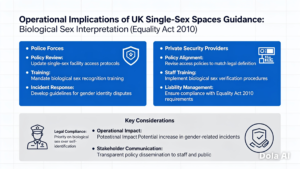 Police officers may be asked to respond to allegations that someone is in the “wrong” single-sex space, but they will often have limited ability to verify sex on demand in a lawful, proportionate, and non-intrusive way.[1][14] This creates a difficult operational gap between public expectations, equality law, and policing powers.[1]
The likely consequences include:
- More low-level callouts and reports, particularly in public facilities and busy venues.[1][14]
- Greater demand on officer time, with disputes requiring scene attendance, explanation, and documentation even where no offence is clear.[1][14]
- Increased of escalation, especially where complainants, security staff, and the reported person disagree about access or identity.[1]
- Higher sensitivity around human rights and discrimination, because aggressive enforcement may engage privacy, dignity, and proportionality concerns.[4][12][14]
Police custody and search contexts may also become more complex. The single-sex spaces guidance does not remove existing legal powers, but it may intensify public misunderstanding about what officers can and cannot do when handling search, detention, or facility-access disputes.[1][14]
Operational implications for private security
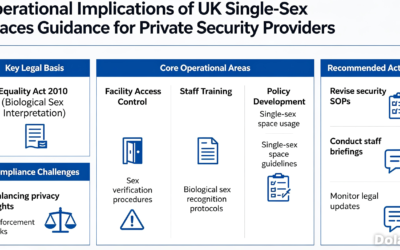
Private security staff are likely to face many of the same disputes, but with less authority and fewer investigative tools than the police.[1] They may be expected to act on complaints from members of the public without any reliable way to confirm whether a policy breach has occurred.[1]
Likely effects include:
- More reliance on site rules and manager discretion rather than immediate enforcement.[1]
- More incident logs, complaint records, and risk assessments to protect venues from liability.[1][14]
- A greater chance of inconsistent decisions between sites, event operators, and contractors.[1][15]
- More conflict between customer service and enforcement, especially where removal or confrontation could damage reputation or worsen tensions.[1]
For security teams, the challenge is that they may be expected to “act” on concerns while still avoiding overreach. That makes clear internal procedures essential, but it also means the guidance may produce more paperwork than certainty.[1][14]
Wider implications
The single-sex spaces guidance is likely to affect both sectors in three broader ways:
- More training requirements
Staff will need guidance on how to respond to complaints, manage privacy, and avoid unlawful questioning.[1][14] - More legal caution
Employers, forces, and contractors may adopt conservative policies to reduce the risk of complaints or litigation.[1][11][14] - More public misunderstanding
Members of the public may assume staff can verify sex instantly, when in reality the law, privacy obligations, and operational limits make that difficult.[1][4]
Assessment
For policing and private security, the biggest risk is not a single dramatic change, but a steady increase in disputed incidents that are hard to resolve cleanly.[1][14] The single-sex spaces guidance may therefore improve clarity at the policy level while making frontline enforcement more complicated, more contested, and more resource-intensive.[1][11][14]
Conclusion
The new guidance is likely to place police and private security under greater pressure to manage access disputes in single-sex spaces, with limited practical tools for verification and a real risk of inconsistency, escalation, and added workload.[1][14] Its success will depend heavily on whether forces and venues are given clear, proportionate, and workable procedures rather than vague expectations.[1][11][14].
Sources:
- [1] www.pinsentmasons.com
- [2] www.bbc.com
- [3] www.facebook.com
- [4] transactual.org.uk
- [5] www.instagram.com
- [6] www.reddit.com
- [7] www.facebook.com
- [8] www.bmj.com
- [9] blog.anthonycollins.com
- [10] www.scottishtrans.org
- [11] www.equalityhumanrights.com
- [12] www.equalityhumanrights.com
- [13] sex-matters.org
- [14] www.gov.uk
- [15] www.gov.uk



0 Comments